
ASJA PACIFIC NORTHWEST NEWSLETTER
For ASJA members in
Alaska, British Columbia, Idaho, Oregon and Washington
April 2024
https://asjapnw.org
In This Issue
From the Prez, The Hero’s Call, M. Carolyn Miller, ASJA PNW President
Taking up Slack: Stop Putting It Off, Sharon Elaine Thompson
Open Mic, Rosemary Keevil
In the Writer’s Nest-Your Office
Dropbox, Bruce Miller
Member News and Announcements
Join us for our April meeting!
M. Carolyn Miller is inviting you to a scheduled Zoom meeting.
Topic: ASJA PNW
Time: April 17, 2024 01:00 PM Pacific Time (US and Canada)
Every month on the Third Wednesday
Join Zoom Meeting
https://us02web.zoom.us/j/87898612924
Meeting ID: 878 9861 2924
This newsletter publishes the first day of each month and welcomes article submissions and photos. Please email the ASJA PNW Newsletter Editor, Maxine Cass, at maxinecass@gmail.com
From the President

by M. Carolyn Miller
ASJA PNW Chapter President
The Hero’s Call
I recently had a coaching session with the Small Business Development Center (SBDC). (The SBDC offers free coaching and free in-depth market research reports to small businesses.) I’d been working with this coach sporadically ever since I moved to Portland. Nearly 80 and a retired CPA who is as woo-woo as I am, she reminded me that I’ve been talking about my own work ever since she’s known me. “It’s time,” she said.
She’s right.
My own work—my dharma, I tell people—focuses on the emotional and spiritual tasks of transition, through the lens of story and gamification. It’s the subject of the book I’m writing, the games and tools I’ve designed and taught, and now the essays I plan to publish. I haven’t focused on this work much since I went back into the corporate world 10 years ago to retool and formalize my writing credentials. (That’s also when I joined ASJA.)
When COVID hit and my last corporate project disappeared, I took a much-needed break. But now, it’s time to launch my own creative darlings. And even though I know the market is finally ready, and I’ve gotten nothing but professional encouragement and cosmic openings such as the recent Institute of Independent Journalists conference (check out their newsletter and the regular Calls for Pitches), I find myself stalling and I know why. I’m scared.
In mythology, the hero answers the “Call to Adventure” and battles dark forces before emerging victorious. In modern life, such heroic calls arrive disguised as transitions. When they do, we can either answer the call and (gulp) step into the unknown or refuse the call and face the consequences. (And there are consequences.)
“You have to write what’s there,” a reader once told me. And so here it is, on the precipice of my own next adventure, dangling over the edge of my next adventure.
M. Carolyn Miller, MA, spent her career designing narrative- and game-based learning. Today, she consults and writes about narrative in our lives and world, the inextricable link between the two, and the critical role of self-awareness in transforming both. www.cultureshape.com

PNW Wildflowers, Shooting Stars (Dodecatheon hendersonii) and Oregon Fawn-lily (Erythronium oregonum), Gold Hill, Oregon. Photo © Maxine Cass

by Sharon Elaine Thompson
Taking up Slack: Stop Putting It Off
Procrastination is not one of the seven deadly sins, but perhaps, for freelancers, it should be. It is one of my strongest skills. It may be one of yours, too.
I procrastinate not only when working on why-did-I-accept-this? projects, but when I want to sit down to the not-yet-paying pet projects that keep me excited and awake at 2 a.m.
None of the usual tricks have worked: not giving myself deadlines, not threatening to withhold chocolate, not promises to provide chocolate. I still go through the four Ps of writing: Procrastination, paralysis, panic, and finally production.
Until recently.
A novelist friend and I were bemoaning our mutual lack of progress on our projects when we decided to try co-writing again. We’ve done this before, usually meeting at a neutral space and writing in sprints. It worked, but eventually, we found too many excuses not to drag ourselves out of the office and ended the effort. This time, we decided to do it via Slack’s video option. (Any co-working program will work for this: Slack, Discord, or Trello.)
Twice a week, 9 a.m. sharpish, we turn on our cameras, chit chat for half an hour or so, discuss what we’re going to do for the next hour, then turn off the sound—and here’s the important bit for us—we keep the camera on.
Guilt is a wonderful thing. When we check in without the camera via Slack’s texting function, we both sneak away to do laundry or dishes or doom scroll—any of a thousand things. But when big sister is watching, we stay nailed in our chairs, hitting keys.
It’s been remarkably effective. I’ve finished my novel’s ugly first draft. My friend has put down almost 30,000 words of hers. Despite breaks for lunch and gossip—most of which, quite honestly, is writing related—for the last three months, we’ve each put in a solid six to eight hours of writing production a week.
Almost more importantly, it has made writing fun and exciting again, as we not only see the words pile up, but we have frequent mutual support. She convinced me to start planning a new series (because working on one isn’t enough). I convinced her to drop a marketing effort that was draining her limited time but wasn’t paying off.
I can’t guarantee co-writing will work for you. But if you have a writing friend—non-fiction, fiction or memoir—who also wrestles with procrastination, it might help you break though the block.
Don’t put off trying it.
Sharon Elaine Thompson has written for jewelry industry trade journals for more than 30 years. She has developed educational materials for industry trade schools as well as for high school textbooks and has written three YA science books. She writes women’s fiction under the name of Liz Hartley and copy edits work for other writers.

by Rosemary Keevil
Open Mic
I was surprised at how nervous I was when it was my turn to do my author reading at the Autobiographies and Memoirs Open Mic Night, a one-hour, online event hosted by the Canadian Authors BC Branch on March 20.
I was one of six authors invited to present. These were our instructions: “Participants are given one minute to introduce themselves and then six to seven minutes…to read from your work.”
To help me prepare for this event, I dug up my notes from my online book launch on October 22, 2020, the same night as the final Trump-Biden debate. My launch began one hour before the debate—I figured I could be a good opening act!
I spent the morning of March 20 continuing to prepare by practicing my intro and my readings out loud and timing them all. Damned if I was going to exceed seven minutes.
In my introduction, I explained my journalism background and gave a brief description of my book, The Art of Losing It: A Memoir of Grief and Addiction. My memoir tells the story of my husband and brother dying in same year when my children were very young, and my subsequent journey through addiction and then recovery.
I had attended these Open Mic evenings before, and all the authors had chosen one seven-minute excerpt, but I was stumped as to what one passage could typify my memoir. I simply couldn’t decide, so I chose to read four shorter excerpts.
In the first reading I chose a passage where my husband is exuding appreciation for my support while he is suffering through brutal chemotherapy and living with a debilitating, terminal illness. It ends with: “I’m glad you are on my team. You are my life.”
In the second reading my young daughters are watching an ambulance taking my husband away from our house and the five-year-old looks up at me and asks, “Is daddy going to die today?”
In the third reading I am in a session with my spiritual counselor explaining how I drove the kids drunk and high and how it was a miracle I did not have an accident. I asked her if I needed a spiritual retreat and she asked, “What about rehab?”
The last reading was the last two sentences of the epilogue: “I will also never lose the guilt I have over how I parented the girls in the absence of their dad, but I have acceptance. It’s what I’m doing about it now that matters today.”
After the last reading I looked up at the camera and said: “After my dentist read my memoir he said, ‘Now I know why you grind your teeth.’”
I received positive feedback from a number of the 17 people in attendance. One note in the Open Mic Zoom Chat was from Frances Peck, membership coordinator for the North Shore Writers’ Association: “Rosemary’s memoir is a frank, poignant account of overcoming life’s blows. I found it engrossing.”
The motto of the Canadian Authors Association is “writers helping writers” and they have been doing that since 1921, when it was founded by a few prominent authors, including Stephen Leacock. The CAA offers regular events, workshops, writers’ talks, webinars, podcasts, networking, and advocacy.
The CAA has 500 members and five branches. The Authors Guild in the US has 14,000 members and 15 chapters. Its purpose and benefits are similar to that of the CAA with a very strong emphasis on advocacy. Membership includes access to lawyers. Both organizations are currently involved in fighting for writers’ rights when it comes to AI.
My Open Mic experience was very positive, and I received an email afterwards from Canadian Authors’ Co-chair, Chris Gorman, “Thanks for reading Rosemary! You have a very powerful story to tell!”
Rosemary Keevil is a freelance journalist and the author of The Art of Losing It: A Memoir of Grief and Addiction. She has been a TV news reporter, a current affairs radio show host, and managing editor of a professional women’s magazine. Rosemary lives in Whistler, British Columbia, Canada.
In the Writer’s Nest-Your Office
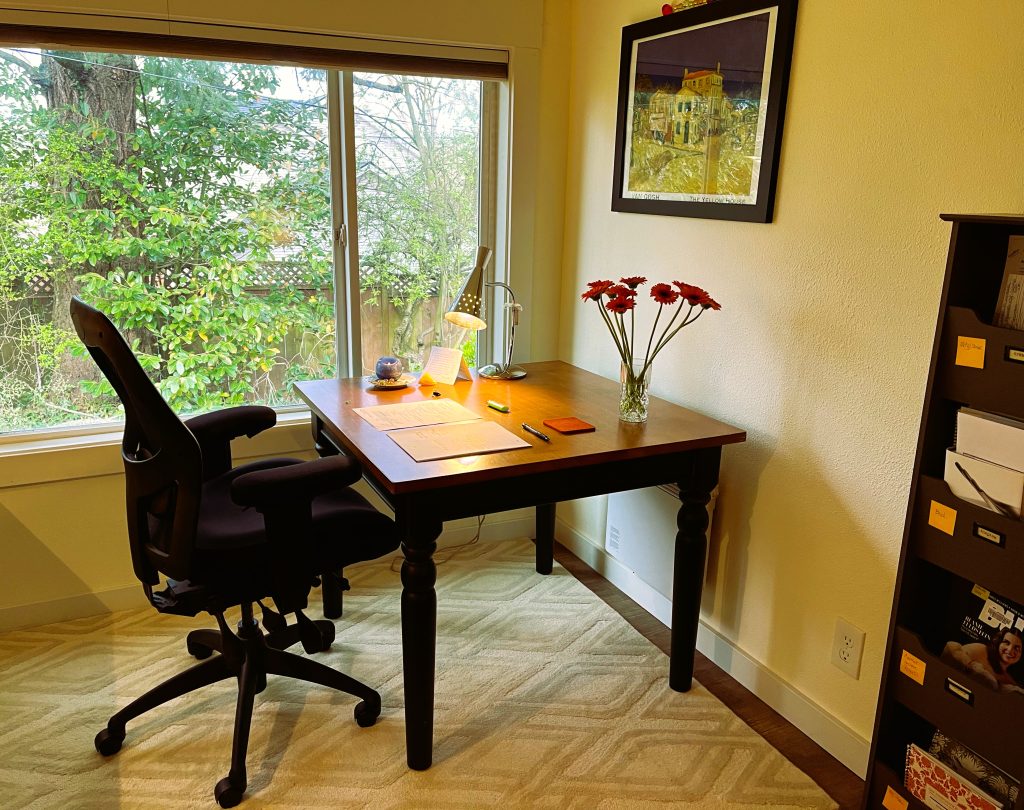
M. Carolyn Miller’s “design and dream” area of her office.
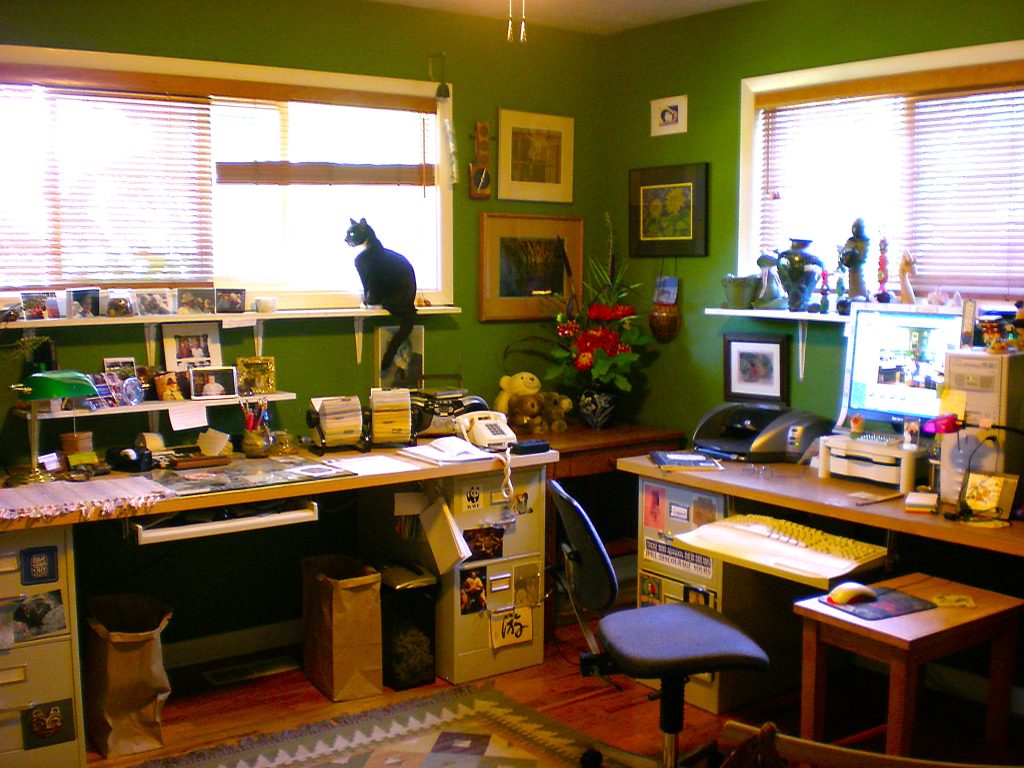
Sharon Elaine Thompson’s office with former mascot, Tinker.
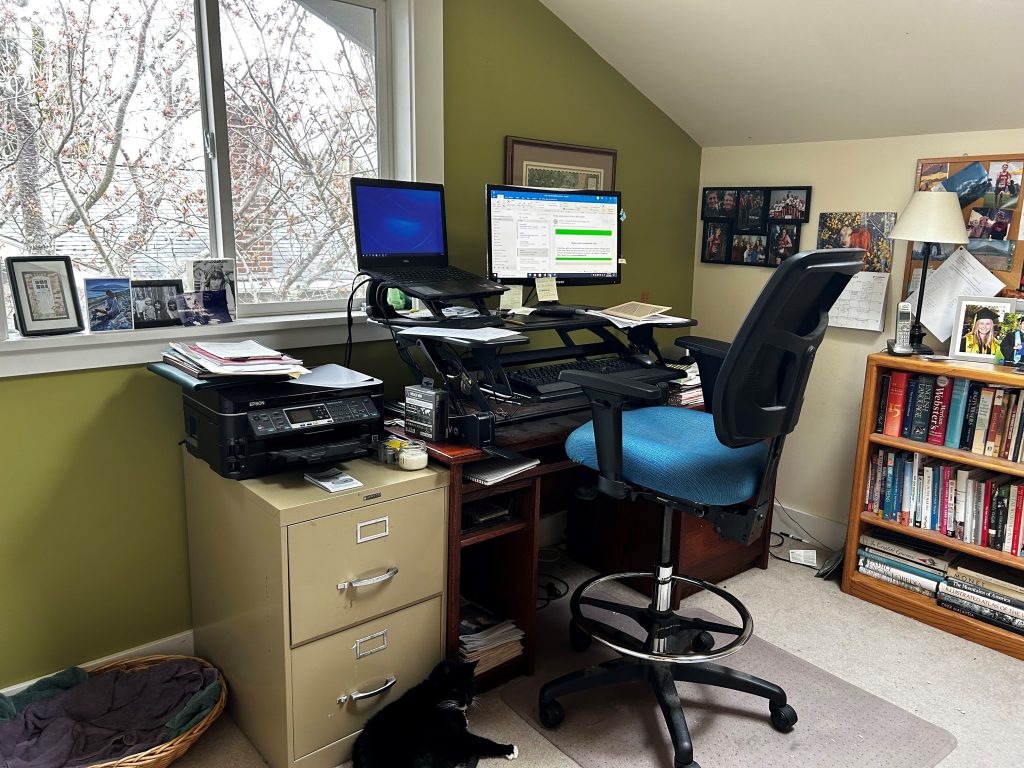
Joanna Nesbit’s office with the cat, Maggie, “who often hangs out there,”
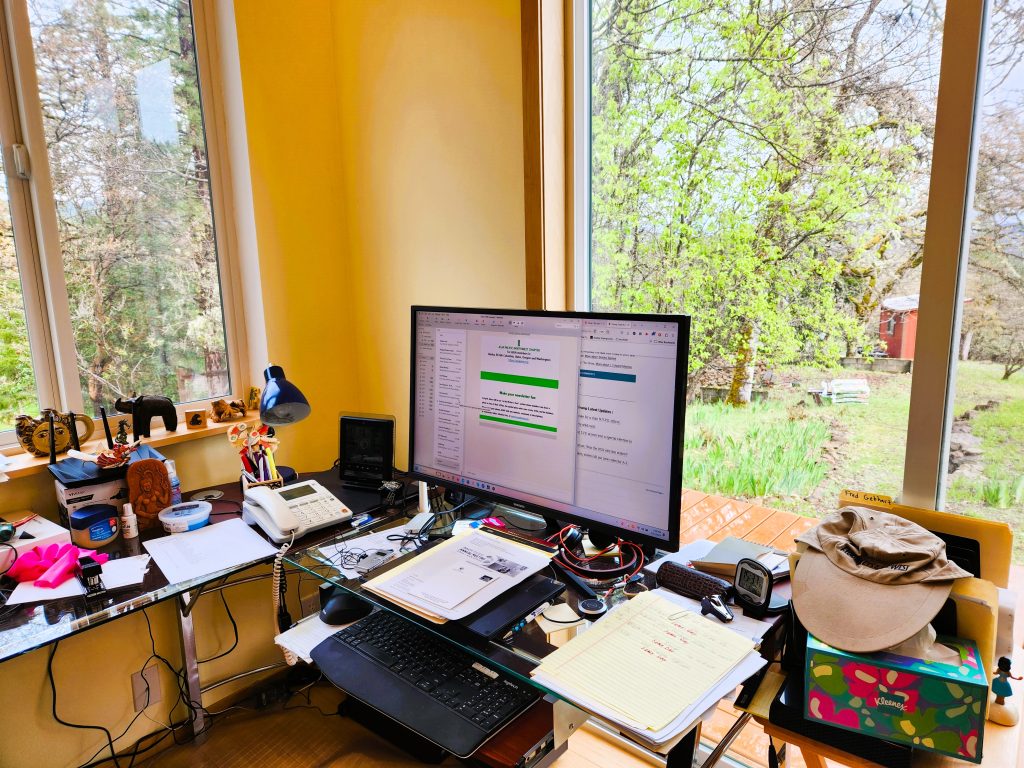
Fred Gebhart says, “An office with views is a welcome distraction when interviews get too tedious…and a constant reminder to focus on work, not the Steller’s jays and gray squirrels outside.“

Michelle Rafter’s office.
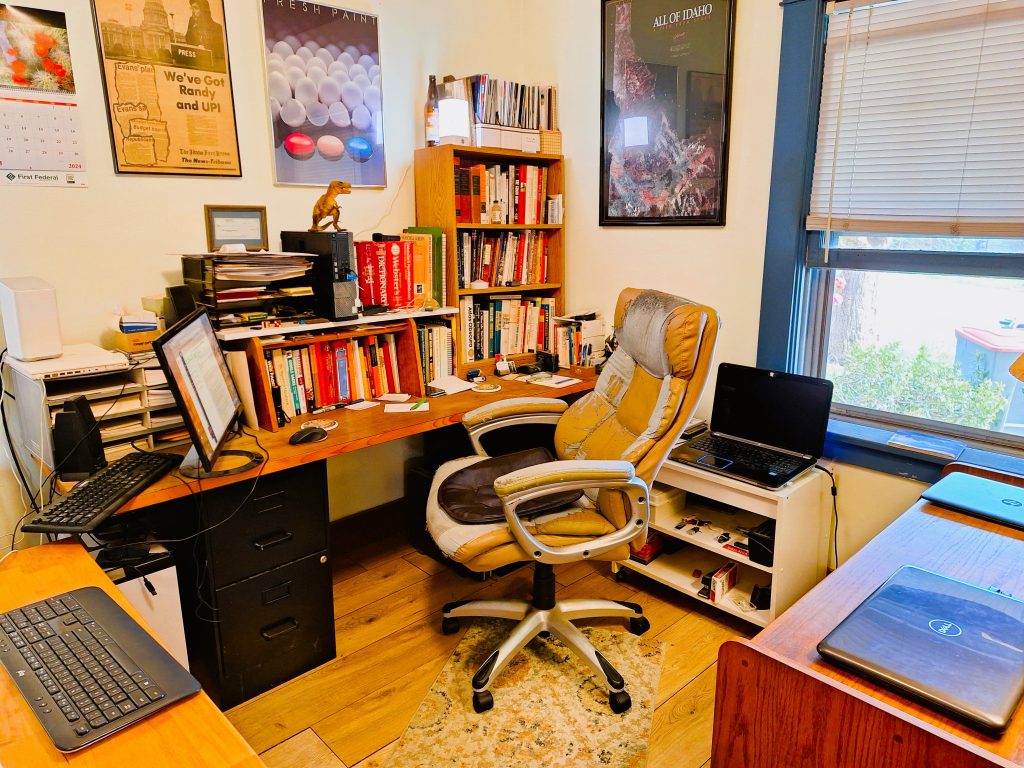
Randy Stapilus’ office.
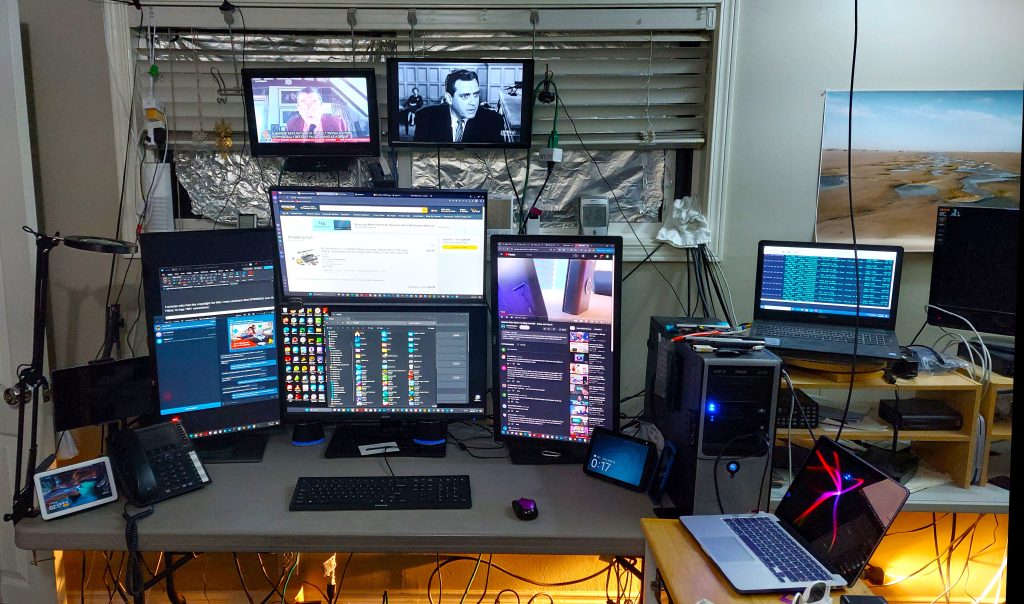
Bruce Miller says his #2 workstation has enough screen real estate for serious work and two TVs at the top provide distraction. Foil on the window blocks the western sun, which became too much of a problem.

by Bruce Miller
Dropbox
I’ve mentioned Dropbox in previous articles. There are features in paid Dropbox accounts that are useful for writers.
Data syncing: With even the least expensive paid account you can have all your data synced across numerous computers and in the cloud. Because I have four different workstations (three in one house and a fourth in another house), I want to be able to access data and important files no matter which station has my fingers. Additionally, the data is also synced on at least two laptops, one a Windows laptop and another a MacBook Pro.
File recovery: The paid account allows you to recover a deleted file by logging into Dropbox’s cloud interface and restoring the file.
File versions: The paid account allows you to recover not only a deleted file, you can also go back several versions if needed.
File upload: Every once in a while, I need a way for someone to upload a file. Two examples: I needed a 1099 from a client. Sending by email was not wise because the name and Social Security number would be visible. A programmer was not able to send the custom software program to me via email because his email service would not allow him to attach a file that ends in exe.
Scan to Dropbox: Many network-enabled printers have the ability to scan to Dropbox and other services, such as Box.com. This feature is kick-ass! I can scan to PDF or JPG and the multi-function machine will automatically send the file into the Dropbox cloud – always into the same folder. I can then go to any Dropbox-connected computer – workstation or laptop – and do whatever I need to do on the file.
I was using this feature before my father died at age 100 in 2018. Because he left estate matters with me, I had a lot of scanning and printing to do. I set up a Brother multi-function printer in his house, which had become mine. With two of the same multi-function machines in two different cities, I was able to scan into a central location and the files were there no matter where I was or what computer I was using. I’ve found distribution of a scanned file to the computers (each with an Internet connection) to be quick, typically within a minute after the upload is complete.
Shared folder: Frequently sharing files with a friend, colleague or client can be a breeze with a shared folder. Each person needs a Dropbox account (free or paid) and enough account space for the files. Dropbox can link up the folder to share between two or more people. As is the case with syncing, a file deleted by Person A will also be deleted from the shared folder in all accounts. Only use this with people you trust – and have backups if you need them.
Before using Dropbox, I used Sugarsync.com. I began having problems with Sugarsync, so I started using Dropbox. In nearly seven years of use I’ve had almost no problems with Dropbox. The $120 per year I pay for the Pro Plan (with 30 days of version history) is well worth it for me.
Seattle resident Bruce Miller is constantly exploring data storage methods, using a combination of internal drives, external USB drivers, Network Attached Storage (NAS) devices, and cloud services. He does not trust any single storage destination.

Spring Blossoms, Medford, Oregon
Photo © Maxine Cass
Member News and Announcements
Darlene West’s essay, Daisy Goodwill and the Montana Rockies, a mix of literary reflection and mountain scenery, appeared in The Smart Set, a journal of arts and culture.
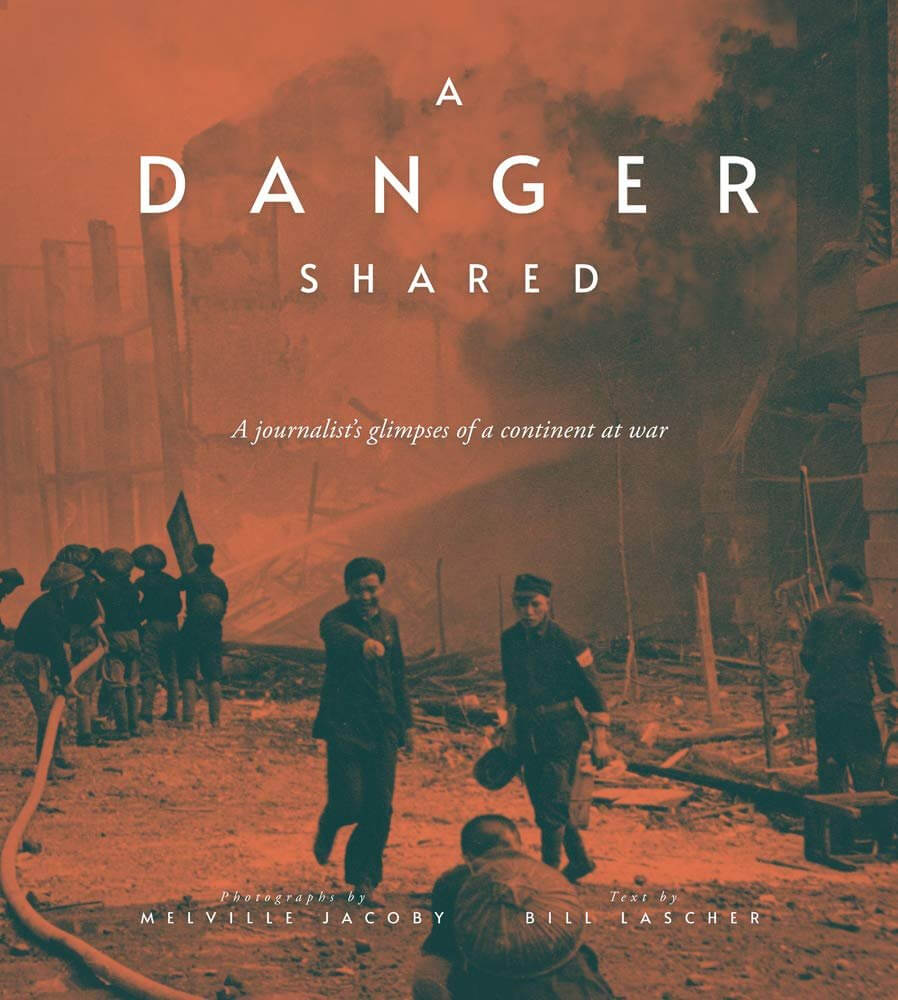
Bill Lascher‘s latest book, A Danger Shared: A Journalist’s Glimpses Of A Continent At War, debuts this month. As Bill describes it: A Danger Shared is a searing visual history of wartime Asia as seen by foreign correspondent Melville Jacoby. In this meticulously curated collection of never-before-seen images, readers experience glamorous Macau soirées and witness wartime Chongqing’s wreckage and resilience. Jacoby treats Filipino fishermen and Hanoi flower-sellers with the same care as the Soong Sisters, Chiang Kai-Shek, and other icons. Through scenes of everyday friendship, toil, and commerce, A Danger Shared documents humanity’s persistence at a cataclysmic historical moment.
L.M. Archer wrote “Why you should try sparkling wine from Uruguay” for The Drinks Business. “Napa’s Quintessa Showcases Biodynamic Practices” appeared in the April issue of Wine Business Monthly Magazine. “Romancing the Clone,” was in Washington Tasting Room.
Joanna Nesbit (joannanesbit@comcast.net) is seeking ideas and contacts for future ASJA PNW meeting speakers.
Portland-based PNW chapter member Michelle Rafter, ASJA publications chair, recently launched the Meet the Member feature on the ASJA Confidential blog. Want to suggest someone for a Meet the Member profile? Email Michelle at michellerafter@comcast.net .
_______________________________________________________________________________________
James Carberry joined other founding chapter members in Portland for lunch on March 15. Carberry was an ASJA PNW member until he and his wife moved to Barcelona before the pandemic.
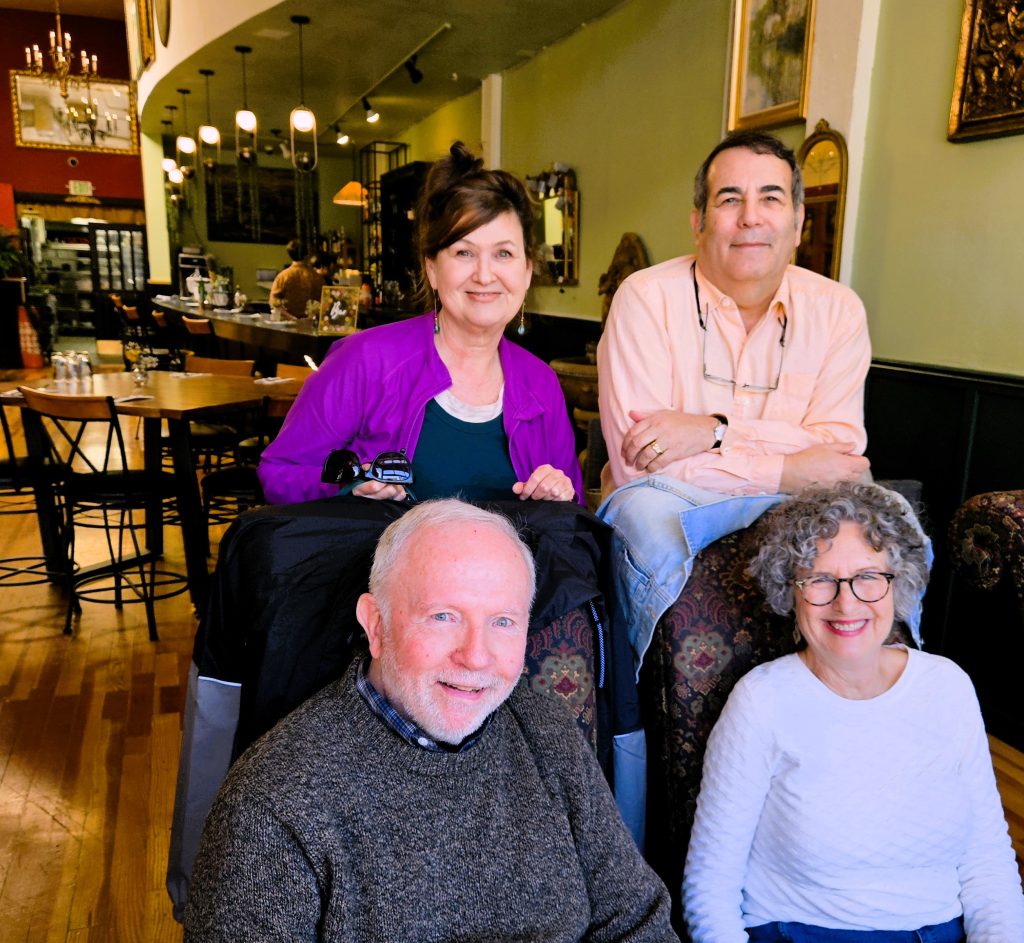
Pictured (back row) Current ASJA member Catherine Kolonko and lifetime ASJA member Howard Baldwin; (front row) James Carberry and ASJA PNW president Carolyn Miller. Photo by Michelle Rafter.
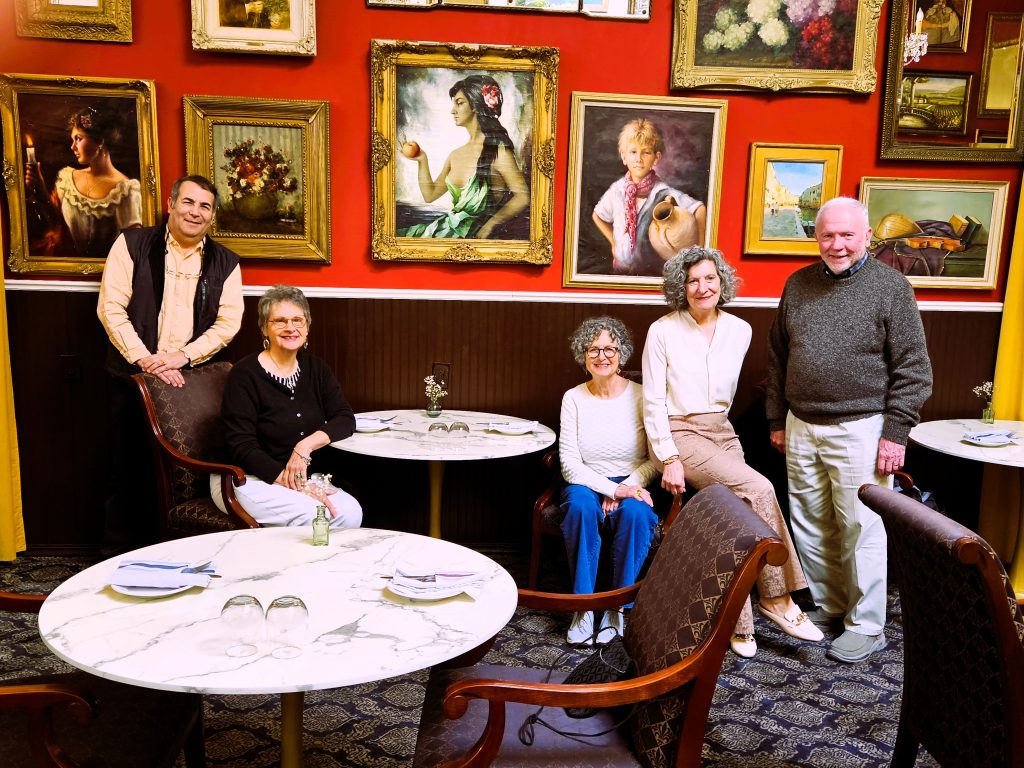
Pictured (left to right) lifetime ASJA member Howard Baldwin, current ASJA members Sharon Thompson, Carolyn Miller, Michelle Rafter, and retired ASJA member James Carberry.
NEWSLETTER PRODUCED BY
EDITOR: Maxine Cass
PROOFREADERS: Catherine Kolonko
TECHNICAL EXPERTISE: Bruce Miller
*All stories are copyright by their respective writers.
*All photographs and illustrations are copyright by their creative makers.
*All rights are reserved to each of them for their own material.