
ASJA PACIFIC NORTHWEST NEWSLETTER
For ASJA members in
Alaska, British Columbia, Idaho, Oregon and Washington
October 2025
https://asjapnw.org
In This Issue
From the Prez, Writer as Mirror, Carolyn Miller, ASJA PNW President
Did You Know?, Bruce Miller
A Story Found While I was Looking for the Absence of Something Else, Randy Stapilus
CC Me, Baby, Rosemary Keevil
Discovering Reasons to Celebrate, Bruce Miller
Tech Short: NotebookLM to the Rescue, Bruce Miller
Member News and Announcements
Our October chapter meeting at 11 am:
Carolyn Miller is inviting you to a scheduled Zoom meeting.
Time: Wednesday, October 15, 2025
11:00 AM Pacific Time (US and Canada)
https://us02web.zoom.us/j/87898612924
Meeting ID: 878 9861 2924
This newsletter is about the craft of writing.
Our newsletter theme for November is “Gratitude.” Please submit articles for the issue!
This newsletter publishes the first day of each month and welcomes article submissions and photos. Please email the ASJA PNW Newsletter Editor, Maxine Cass, at maxinecass@gmail.com .
From the President

by Carolyn Miller
ASJA PNW Chapter President
Writer as Mirror
I recently completed a client article on thought leadership as a marketing tool for small businesses and solo practitioners. I have been circling around this topic for years, in part because writers often, coincidentally, fall into this category.
As part of my research, I referred to an article I’ve saved for years by David Sessions. Sessions was a doctoral student at Boston College in 2017 when he published “The Rise of the Thought Leader: How the superrich have funded a new class of intellectual” in The New Republic. He helped me understand the difference between the thought leader and the public intellectual in society, and how the former is often mistaken for the latter.
The public intellectual was historically an academic who sat outside of society and objectively shared what he/she/they saw, regardless of others’ agendas. Think Noam Chomsky or Timothy Snyder. Such creatures are in short supply these days, given the marriage of corporate agendas with university funding.
The thought leader, on the other hand, has a very specific financial agenda. The work is similar—to conduct studies, analyze the research, and surface conclusions—but the end goal is to set the company up as an expert and build an on-ramp to its products and services. (Examples include IBM and McKinsey & Co., whose studies I refer to, and whose consulting services are coincidentally sought out worldwide.)
In his article, Sessions introduced an opportunity for writers to step into the narrow space between academia and corporate money. He has done just that, operating in that space as a journalist. He is also offering writers, myself included, a model for how to do the same.
“The whole point of being creative,” noted actress, playwright, producer and activist Danai Gurira, “is that you’re tapping into a time of reflecting society back to itself that it might not even be aware that it needs yet. That’s what the artist’s gift is.”
If there was ever a time to do that, it is now.
Carolyn Miller, MA, spent her career designing narrative- and game-based learning. Today, she consults and writes about narrative in our lives and world, the inextricable link between the two, and the critical role of self-awareness in transforming both. www.cultureshape.com
Did You Know?
Beatrice Schapper was the only female founding member of the Society of Magazine Writers. She gave aspiring magazine writers a close look into magazine writing in the 1950s and 1960s in the 1970 book Writing the Magazine Article: from Idea to Printed Page by the Society of Magazine Writers. As editor, she included type-written manuscripts with hand-written editing and letters from typewriters. Schapper was an energetic and greatly respected writer, teacher, and member of the Society.
—From Bruce Milller

by Randy Stapilus
A Story Found While I was Looking for the Absence of Something Else
There’s an old saw long circulating in journalism schools about the reporter dispatched to cover a wedding. After a while he returns to the newsroom and tells his editor he had no story, because there wasn’t a wedding. The couple fought, someone set fire to the church and the place erupted into a riot. So, no story…
I was reminded of that one day a few weeks back when I set out to walk and drive around Portland, in search of the urban horrors the Trump Administration has described more or less as reducing the city to smoldering rubble (and therefore in need of federal troop presence). I was fairly sure the terrors so described – and repeated in many and sometimes unexpected quarters – would not be evident, but best to make sure.
My original thesis held. From all appearances, for better or worse, Portland in broad brush appears to be much the same as it was two or three decades ago, blemished in places but largely peaceful and prosperous. But I also found something of specific interest.
One place I did know specifically has been drawing protests, vandalism and low-level violence is the building south of downtown housing, the Immigration and Customs Enforcement (ICE) regional office. The situation there has been described in a number of news articles, but usually in the context of specific incidents, not often conveying the day-to-day atmosphere.
So that was what I examined, and what I found was unexpected. The building or at least its exterior has become a mini-community of its own, with ICE personnel almost barricaded inside, and others – immigrants and the people working with them, alongside protesters – regularly on the sidewalks outside. The protesters are not of one kind. Many are seniors and members of religious groups or concerned about philosophical matters. At night a smaller group often of about a dozen to twenty, more prone to vandalism, bottle-throwing and yelling, sometimes appears. The various types of protesters seem to have little to do with each other.
(Shortly after my article ran in the Oregon Capital Chronicle, Oregon Live looked at the scene there as well, making some similar points.)
It’s a more complex and interesting story than the monochrome image news stories often present. The point here being, a story found while I was looking for (the absence of) something else. Some of the better stories turn up that way.
Randy Stapilus is a writer and publisher at Carlton, Oregon. He has written and published a number of books and weekly columns about Oregon and Idaho, which with other writing appears on Substack. https://stapilus.substack.com/

by Rosemary Keevil
CC Me, Baby
We typed our TV news stories on typewriters using paper that was three layers thick, separated by pieces of carbon paper, so that three copies would be made: one for me, one for the producer and one for the video editor. Yes, carbon copy. That would be CC. How many people today, especially younger ones, have any idea whatsoever about the origins of CC?
It was a damn nuisance. If you made a mistake, you couldn’t just use Wite-Out. You either started over or put x’s through the mistake making for very messy copy.
Typing into a computer completely altered my work as a journalist and writer. Mistakes are a cinch to correct. I can write faster than on a typewriter and not get my knickers in a knot if I make a mistake.
What’s developed since I started using a computer is that I now actually think into my fingers on the keyboard. Sometimes, such as in workshops, I am given an exercise to write long hand to create a story. But I find I am totally handicapped. I can’t write. I can’t think.
And there are programs that will transcribe interviews. Oh My God. Transcribing is an agonizing, time-consuming process.
Yes, thanks to technology, my job as a journalist has changed dramatically since those days four decades ago.
Rosemary Keevil is a freelance journalist and the author of The Art of Losing It: A Memoir of Grief and Addiction and The Truth About Losing It: Voices on Grief and Addiction (September, 2025). She has been a TV news reporter, a current affairs radio show host, and managing editor of a professional women’s magazine. She was a can-can dancer, in Dawson City, Yukon, and drives a mean motorboat. Rosemary lives in Whistler, British Columbia, Canada, with her partner and two doodles, Romeo and Hamlet.

by Bruce Miller
Discovering Reasons to Celebrate
On May 5, 1982, my mother, Phoebe Novella Small, was driving the 80-mile trip from Lincoln, Nebraska, to her mother’s place in Marysville, Kansas, for a Mother’s Day social function.
About half-way there she swerved off the road, back onto the road, and collided head-on into another car. She died two hours later in a Beatrice, Nebraska hospital at age 62. A subsequent autopsy never revealed the underlying medical problem that caused her to swerve. I was relieved. The people in the other car had only minor, if any, injuries.
My mom’s death was an abrupt change of plans for everyone. My parents were to come to Seattle and visit me the following week. I quickly prepared for a trip to Lincoln.
After a month with the family, I returned to Seattle. I began thinking of a way to brighten my grandmother’s days. Birthday parties were an option, but mundane. What is a good reason to have a party? I kept this question in the back of my mind for months.
In 1983 my father mentioned my grandmother’s poetry. What? She had been writing poetry for 50 years. I never knew this. At the time I was writing magazine articles and took immediate interest. My grandmother was willing to send me all of her poems. Most had a religious bent that reflected her devout Christian beliefs.
I seized on the idea that a book signing party for her poetry would be a great excuse for a party. Thus began a year-long project to produce and publish her poetry. My grandmother was on board, probably thinking she was doing her grandson a favor.
My goal was a chapbook of about 40 pages. In 1983 and 1984, creating even a small book was long before desktop publishing on personal computers and home laser printers. Typesetting was expensive.I knew I could print on the expensive laser printers in the computer center at the University of Washington’s medical center for a few dollars.
At the computer terminal I would type in the poems and eventually send them to the printer in an inaccessible room occupied by a staff person.
After several trips to the UW medical center’s computer room, I was finally able to do layout onto large sheets of paper for the professional printer.
June 30, 1984 was the date I worked out with the Marysville Library and everyone else for the book signing party. Getting the word out started with a simple card mailed in envelopes announcing the event with one of her short poems:
What is this Journey I am taking,
Is it for loss or gain?
It is my life’s work I am making
A daily pleasure, not a pain.
If it should last a few short years,
Or three score years and then,
I’ll trust in God for guidance
Along with righteous men.
And when at last ’tis over
I want my God to say
“Well done! My faithful servant
Thy journey ends today.”
1932 (then 33 years old)
In those days, word of mouth and party phone lines were ways to spread information.
The local newspaper was also a primary source of information and announcements for the 3,000-plus residents of Marysville, Kansas, and the 11,000-plus residents of Marshall County.
I sent news releases to the local weekly paper. The Marysville Advocate ran at least one announcement and three follow-up articles.
At the event, my grandmother shared smiles and connections with old friends. One friend of hers, Anna Graham, traveled about 475 miles from Arkansas. The poetry publication, “My Journey,” nearly sold out, but that was not the goal.
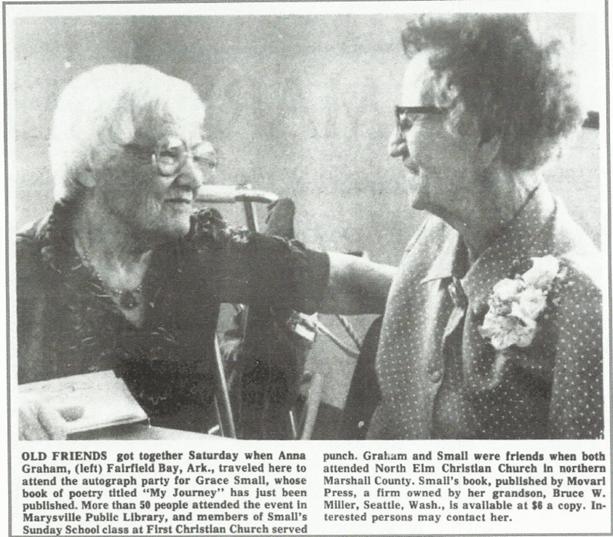
Above image: June 1984, The Marysville Advocate.
Birthdays are great celebrations. Discovering other reasons to celebrate can bring great joy to one or many people. And the role and reach of small, local newspapers was appreciated and should not be forgotten.
Bruce Miller attributes part of his interest in the written word to his Grandmother’s sister, Alice Potter, who, as a school librarian, kept a steady flow of books coming his way while he was growing up.
Tech Short: NotebookLM to the Rescue
While going through old organizational newsletter files I ran across a reference to an award. I should look into this, I thought. But because I was on a different mission and didn’t want to lose my focus, I made a mental note of the reference. Sort of.
When I finally had time to investigate, the only thing I could remember was “SMW-B”. Yes, just those five characters. I knew these five characters were somewhere in 230 PDF files, which I had on a local computer and in NotebookLM.google.com.
Why not give NotebookLM a shot? Here’s the prompt I used:
Find information about an award that was mentioned in these files that has these characters: “SMW-B”.
About 20 seconds later I had a summary that began with these two sentences:
“The award referenced by the characters “SMW-B” is the SMW-Beinecke Grant or Beinecke-SMW grants. This program was a system of grants-in-aid managed by the Society of Magazine Writers (SMW) in collaboration with the Beinecke Foundation.”
Sometimes the smallest of clues can put you on the right path for more investigation. Why not let technology help?
Bruce Miller embraces technology — most of the time — and likes to find ways to plow through data without falling asleep.
Member News and Announcements
Joanna Nesbit has been writing about the student loan landscape regularly for Credible.com. Recent articles include Federal vs. Private Student Loans: What’s the Difference? and How to Pay Off $200,000 in Student Loans: Repayment Strategies That Work. She also had a This is 50 article, Will I Ever Be Able to Retire?, appear in the August/September issue of AARP The Magazine. She’s currently working on a faculty profile for a college magazine and writing athlete profiles for a magazine associated with a private high school in Massachusetts. Most importantly, she and her husband are planning an October trip to Portugal.
Carolyn Miller‘s “Thought leadership in vet med: Leading the way to better marketing ROI” was published in The American Animal Hospital Association magazine in August.
Bruce Miller has added to the asjapnw.org website including a list of articles written for the chapter newletter since it began in November, 2018. (https://asjapnw.org/newsindex/). Also included are articles on PNW chapter history, national awards, several books and a list of conferences. Find the history through the History option in the menu.
Joanna Nesbit (joannanesbit@comcast.net) is seeking ideas and contacts for future ASJA PNW meeting speakers.
NEWSLETTER PRODUCED BY
EDITOR: Maxine Cass
PROOFREADER: Catherine Kolonko
TECHNICAL EXPERTISE: Bruce Miller
*All stories are copyright by their respective writers.
*All photographs and illustrations are copyright by their creative makers.
*All rights are reserved to each of them for their own material.