
ASJA PACIFIC NORTHWEST NEWSLETTER
For ASJA members in
Alaska, British Columbia, Idaho, Oregon and Washington
November 2025
https://asjapnw.org
In This Issue
From the Prez, Grief and Gratitude, Carolyn Miller, ASJA PNW President
Did You Know? Betty Freidan’s The Feminine Mystique, Bruce Miller
The Lean Writer, Fred Gebhart
A Dog’s Breakfast: Recording My Audio Book, Rosemary Keevil
Gratitude in Nebraska, Bruce Miller
Tech Short: AI Prompt for Fast Folder Deletion, Bruce Miller
Member News and Announcements
Our November chapter meeting at 11 am:
Carolyn Miller is inviting you to a scheduled Zoom meeting.
Time: Wednesday, November 19, 2025
11:00 AM Pacific Time (US and Canada) https://us02web.zoom.us/j/87898612924
Meeting ID: 878 9861 2924
Our newsletter theme for December is “Celebrate.”
Carolyn recently read an article in Writers’ Digest about the strange habits of well-known writers when they wrote, e.g., “Steinbeck kept a stack of one dozen pencils atop his desk,” per the November/December article, “Embrace your Strange.” You can’t link to the article unless you’re a subscriber, but we’re asking for the next newsletter:
Do you have a writing ritual that precedes your actual writing? Share it for the December newsletter.
Carolyn: I make my espresso, light a candle, and then sit in silence for a moment to see what creative project draws my attention. Then, I set to work, and write or design.
Please submit articles for the issue!
This newsletter publishes the first day of each month and welcomes article submissions and photos. Please email the ASJA PNW Newsletter Editor, Maxine Cass, at maxinecass@gmail.com .
From the President

by Carolyn Miller
ASJA PNW Chapter President
Grief and Gratitude
When I first moved to Portland, a dull pall hung over my life, punctuated with the stress of setting up a new home (I’d only moved with my office, my books and my clothes), and compounded by grey winter skies after 40 years of Colorado sunshine. Only later did I realize it was grief.
Despite that, I pushed myself out into this new, strange city of bridges. I went to networking events. I attended the local chapters of professional business organizations. I started the local chapter of ASJA.
I remember that first ASJA chapter meeting. I was late. I was stressed out from the drive down unfamiliar streets. I forgot my reading glasses. But when I walked into the coffee house and got to know the writers whose faces ringed the table, I relaxed. These were my people.
Members have come and gone from our chapter since 2017 when our group first gathered, but a core group has remained, faithfully showing up for monthly meetings, holiday gatherings, and one-on-one lunches. We’ve seen each other through the gnarly process of obtaining unemployment during COVID-19, given each other leads that led to work, and supported each other as we all navigate the life of a writer in the age of AI.
I met up with one such member when I took a short road trip south and stopped in Salem to see Sharon Thompson, a now-former ASJA member. We met up at a local park, walked and talked, sat and ate our lunches, and then walked and talked some more—about writing and our writing projects, about the future of writers in a world gone mad, and about, well, life, and the life of a writer specifically.
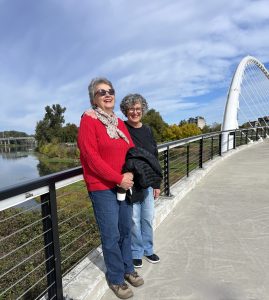
When I moved to Portland, I left behind a lot of old friends in Colorado. But what I realized recently is that in the time I’ve been here—nine years now!— the new friends I made have suddenly become old friends without my realizing it. And not just any friends, but writer friends. That is the jewel in the crown.
M. Carolyn Miller, MA, spent her career designing narrative- and game-based learning. Today, she consults and writes about narrative in our lives and world, the inextricable link between the two, and the critical role of self-awareness in transforming both. www.cultureshape.com
Did You Know? Betty Friedan’s The Feminine Mystique
Betty Friedan, successful and controversial magazine writer in the 1950s and 1960s, was frustrated that women’s magazines would not buy and publish many of her articles championing women’s rights. One magazine editor said of her opinionated work that she’s “gone off her rocker.”
In 1956, Friedan joined the Society of Magazine Writers (SMW, now the American Society of Journalists and Authors). At an SMW meeting she heard how Vance Packard, also an SMW member, was frustrated by rejections of magazine articles that might offend magazine advertisers. He decided to put his research and thoughts into his book The Hidden Persuaders, published in 1957. Frustrated Friedan seized on the book idea, which became the well-known The Feminine Mystique, published in 1963.
Grateful for the benefits of SMW membership, Friedan appeared on conference panels and was an active member of the Society.
—From Bruce Milller

by Fred Gebhart
The Lean Writer
Are you a lean writer? The question goes to the waste in your writing business, not your waist. And I didn’t know either until a neighbor suggested The Lean Farm (Ben Hartman, Chelsea Green Publishing, 2015). Hartman’s subtitle says it all: How to minimize waste, increase efficiency, and maximize value and profits with less work.
Most of us don’t raise veggies or critters, at least not for profit. We raise ideas. And idea farming, aka writing, has a production cycle like any other product and service: Have an idea, gather information, filter information into coherent flow, turn the filtered information into a product, deliver it to a buyer, and collect payment.
If that sounds like a production line, it is. “Lean” was developed in Japan in the 1940s and helped turn Toyota into one of the largest vehicle manufacturers in the world. Lean is based on a simple idea: capacity = work – waste.
“Work” is whatever adds value for the customer, the client buying your writing. “Waste” is everything else in your business. The most effective way to add value is to cut waste.
For a writer, waste is anything that doesn’t put words on a page (or whatever medium you’re writing for).
Muda, the Japanese word for waste, is more than the scribbled notes and overused Post-it® notes in the trash can by the desk. Muda is physical waste plus concepts like idleness, futility, and uselessness.
For Lean purposes, there are two kinds of waste, avoidable and unavoidable.
Unavoidable waste are things that don’t directly add value that you can’t avoid—things like filing tax returns or buying new printer cartridges.
Avoidable waste is all the other time wastes we’d be better off without—scrolling through Facebook, reading unnecessary email listservs, newsletters, etc.
Avoidable waste is not always obvious. Take supplies, things like printer paper.
We have a separate building for office space, a joy after 30+ years of sharing a spare bedroom or the dining room table. I used to keep cases of printer paper in the garage, easy to unload along with everything else after shopping.
But every time I had to get a new ream of paper for one of the office printers, I had to walk up to the garage, pull a ream, and walk back to the office. It only took 5 minutes or so, but those five minutes wasted about $12 worth of productive writing time.
Instead of costing about $3 per ream, the paper costs about $15 a ream.
I now stop at the office first and unload cases of printer paper there. Since we use around three cases yearly, 36 reams, that one simple step, putting supplies where they are actually used, has saved over $400 in wasted time and improved the bottom line.
Reading The Lean Farm is most definitely not Muda.
Fred Gebhart is a medical writer in Southwest Oregon. He has spent years trying to work leaner, not harder.

by Rosemary Keevil
A Dog’s Breakfast: Recording My Audio Book
When I was a child, I had a lisp. I could not say my r’s and my s’s, so I pronounced my name Wothemawee Pawwett (Rosemary Parrett). My mother enrolled me in speech therapy on Wednesday afternoons from kindergarten to second grade.
When I grew up, I became a bwoadatht (broadcast) journalist, a TV news reporter. After that, I had my own morning, drive-time, current affairs radio talk show.
I was determined to voice my own audio books when the time came. That conviction came from a deep-rooted psychological place.
In 2021, I voiced over my memoir: The Art of Losing It: A Memoir of Grief and Addiction. I recorded it at GGRP Sound, a full-service recording studio in Vancouver, British Columbia. They were very professional and it was a great experience, so I contacted them again to voice my short (76-page) research book, The Truth About Losing It:Voices on Grief and Addiction.
My preparation for broadcasting always started in the car en route to the studio, harkening back to the days when I did the early morning radio show. I exercised my tongue and my lips in the car as I drove to work, repeating loudly:
“EEEEE…”: long “e” vowel sound, lips stretched as in a strained smile.
“OOOOO…”: long “o” vowel sound, lips pursed as about to kiss.
“Ahhhhhhh…”: short “a” vowel sound, lips as round and wide open as possible and tongue stretched out as far as possible.
This limbers up the lips and tongue and makes other drivers think you are insane.
When I arrived at GGRP I was introduced to the technician, José. He directed me to the recording booth equipped with a stool, a large microphone on a stand and earphones. Then he went to the small control room. It was just me in the recording booth and José, whom I could see through the glass separating the two rooms, a setup with which I am very comfortable.
I donned the earphones so José could talk to me. He cued me when he started recording and I went for it.
I am not the least bit nervous being around the microphone, but I do tend to garble my words. I need to concentrate on talking purposefully. My lisp also tends to return when I get tired. So, it’s important to pace myself. There is a voice in my head the whole time repeating…Slow down, Rosemary. Slow down, Rosemary.
During the recording, I keep liquid at hand. This time round it was a McDonald’s Diet Coke, my current addiction. José recommended a hot lemon ginger tea to clear the throat. Last time I just sipped on water.
The entire experience is tedious, especially when I keep repeating the same line and making the same mistake. I was unaware of the of multitude of mistakes I made.
I received a four-page PDF of a list of flaws flagged for pickups requiring a redo. There were 125 spots, marked by a specific time. I am booked for two more hours next week to fix my blunders. There were 20 times where I mispronounced the word “substance.” The book is about addiction, also called substance abuse, hence the repeating of the word “substance.” That made me want to call this story, “A Dog’s Breakfast.
Other flaws included, “page rustle” and “stomach noise.”
Professional voice actors only record four hours at a stretch, so the studio director booked me in for two four-hour sessions for the current book. I didn’t generally make it through a page without a pickup. I took a small break about every 45 minutes and a longer one half-way through. I voiced the entire book in four hours.
The original memoir took 30 hours to record 308 pages over the course of a week with another 30 hours to edit those pages. The total cost was $9,450 (CDN). Cost per hour:
Recording rate: $200
Editing rate: $150
I can’t say if the availability of the audio book increased the sales of my memoir, but I know as a reader that I expect there to be an audio version of whatever book I am reading. As an author I am determined to provide an audio book for any book I write, and I am determined to voice it myself no matter how laborious and humiliating that may be.
Rosemary Keevil is a freelance journalist and the author of The Art of Losing It: A Memoir of Grief and Addiction and The Truth About Losing It: Voices on Grief and Addiction (September, 2025). She has been a TV news reporter, a current affairs radio show host, and managing editor of a professional women’s magazine. She was a can-can dancer, in Dawson City, Yukon, and drives a mean motorboat. Rosemary lives in Whistler, British Columbia, Canada, with her partner and two doodles, Romeo and Hamlet.

by Bruce Miller
Gratitude in Nebraska
AI (Artificial Intelligence) has come to Nebraska, but original writing fills the Larksong Writers Place in northeast Lincoln, NE.
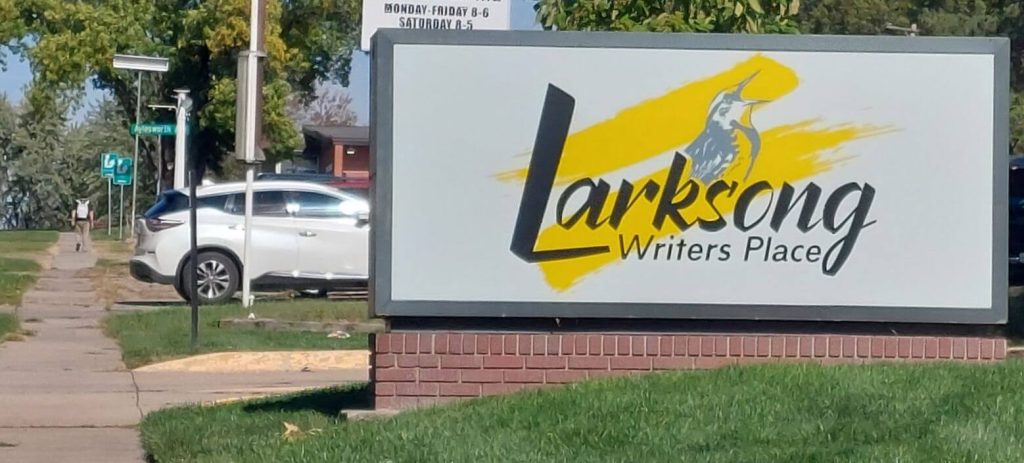
Karen Shoemaker had a dream and a desire to pay back the gratitude of a good life, encouraged in part by scholarships to various higher-education schools for her own writing endeavors. Karen says Larksong is a “gratitude legacy project.”
Karen recognized the isolated nature of writing and the support a literary community can give to writers. Five years or so before Larksong, she was organizing weekend retreats known as Write on the River, inviting writers to “join us for a weekend of peace, permission, and productivity.”
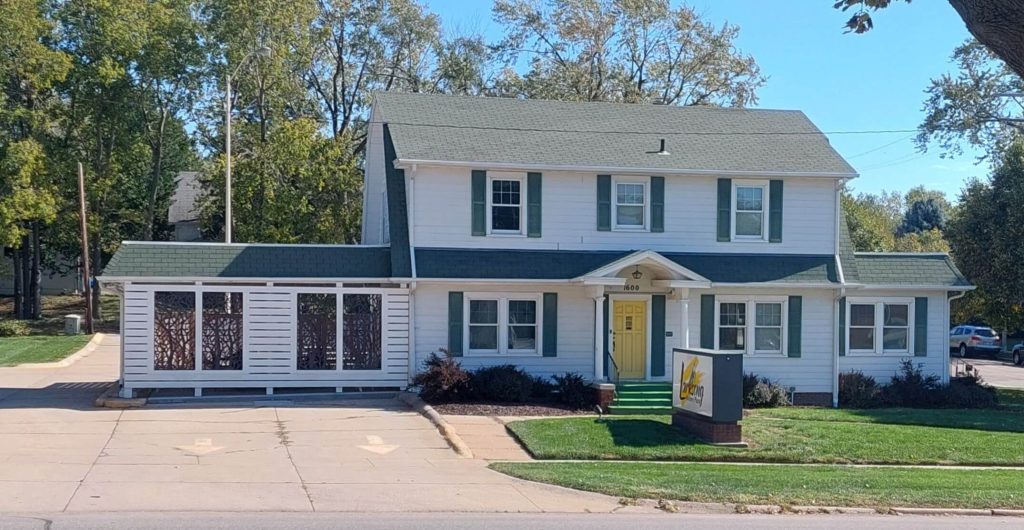
Retreats to different places had its appeal. But so did an address — a fixed physical place — for a supportive literary community. COVID-19 delayed the search for a physical space, but also provided enough time to be looking around Lincoln for the right place. And then she saw it: 1600 N Cotner Blvd. The problem: a bank branch was occupying the building, originally a residence.
Karen kept thinking the bank’s building would be the right place. It had visibility and an existing parking lot. As Karen puts it, “I wished the bank out of existence.” That might have encouraged the bank to open up an office in a newer area with more traffic. As it turns out, the owners of the bank were big arts supporters, so a deal got done.
Karen wrote in the Larksong blog in August 2021, “At a few minutes after 9 a.m. on Monday, July 12, 2021, 1600 N. Cotner Blvd. in Lincoln NE became the official home of Larksong Writers Place. . . On Thursday, July 15, the Larksong board hosted an Open House to invite the public to see where we were starting out and join us in dreaming and planning where we will go. . . Reports from the field (i.e. people who stood around outside when it got too crowded inside) said the parking lot was full, the streets around us were full, and people were walking blocks to get to us.”
The Larksong Writers Place has become a meeting place for other writers’ groups, including a poetry group and military service veterans.
As Executive Director of Larksong, Karen works hard to cultivate classes that fill a need and are not duplicated. She regularly reviews class offerings by the local educational institutions–and even national online classes–before initiating a new course.
Any fee-based course also includes pay for the instructor, one of Karen’s commitments.
Now going on five years, Larksong, apparently Nebraska’s first writing place, is continuing development of on-site and online meetings and courses. Larksong plans to put Nebraska on the literary map.
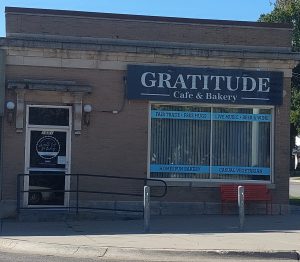
By chance, diagonally across the street from Larksong, is the Gratitude Cafe & Bakery, which at one time held events for writers and musicians. Some might take that as a good omen for a “gratitude legacy project.”
Larksong: https://larksongwritersplace.org
Seattle resident Bruce Miller discovered Larksong because his brother has lived directly across the street from the Larksong building in a house that has been in the family since the late 1920s.
Tech Short: AI Prompt for Fast Folder Deletion
I wanted to zip up a main Windows folder – with all its sub-folders and files – for long-term storage. Properties for the main folder showed 6,238 files in 3,642 folders. I knew there were a lot of empty folders among them, which I did not want to include in the zip file. Going through 3,642 folders to see if they were empty and then delete if empty would have taken several hours, if not days.
I gave Copilot this prompt: I need a windows 11 script that will start with a parent directory and recursively go through subdirectories and give me a list of all subdirectories that are empty AND delete those empty directories.
A few seconds later, I had a 17-line Windows PowerShell script that needed a simple change to indicate the starting directory. After that change I ran the script, which took 5-10 seconds to run. The initial folder count of 3,642 was reduced to 1,257!
Little scripts from AI can save LOTS of time
Bruce Miller embraces technology — most of the time — and likes to find ways to plow through data without falling asleep.
Member News and Announcements
Michelle Rafter recently finished writing a 10,000-word e-book, “Building an Independent Writing Business,” which ASJA will be giving away to anyone who joins the organization during the current membership drive between now and the end of the year. The book is for writers who want to level up their careers, professionals for whom writing is a second (or third) act, and recently laid-off journalists or other writers who are working for themselves for the first time. It’s in design and layout now and when it’s finished will be sent to anyone who’s applied and been accepted. It’ll also be available for free to current members, downloadable from the members-only side of the ASJA website when it’s available. She says, “The e-book was a labor of love for me, I don’t get a penny, it’s my way of giving back to an organization that’s been good to me and my career. Please help spread the word!
Michelle is going to the Gathering of the Ghosts ghostwriting conference in New York Nov. 10-11. She’ll be representing the ASJA board at a lunch on Monday, Nov. 10, where the 2025 Andy Awards for ghostwriting will be announced. ASJA is an Andy Awards co-sponsor and Michelle is part of the awards organizing committee.
Bruce Miller has added to the asjapnw.org website including a list of articles written for the chapter newletter since it began in November, 2018. (https://asjapnw.org/newsindex/). Also included are articles on PNW chapter history, national awards, several books and a list of conferences. Find the history through the History option in the menu.
NEWSLETTER PRODUCED BY
EDITOR: Maxine Cass
PROOFREADER: Fred Gebhart
TECHNICAL EXPERTISE: Bruce Miller
*All stories are copyright by their respective writers.
*All photographs and illustrations are copyright by their creative makers.
*All rights are reserved to each of them for their own material.